( 01 )
the moment that changed everything
"Who are you?"
Three words that broke my husband's heart.
It was our last visit with his grandfather, a man who had taught him to walk, who never missed a birthday. After two major strokes, his dementia and Alzheimer's had progressed rapidly. He sat looking at my husband with confusion and frustration, unable to remember the grandson he'd loved for 30 years.
In that moment, we improvised a simple game. We pulled out family photos and gently asked, "Who is this?" When he got one right (recognised his daughter, remembered a grandchild's name) his whole face lit up. No pressure. No judgement. Just connection.
That was the day Lights On was born.
( 02 )
CHALLENGE
More than 770,000 Canadians currently live with dementia, a figure projected to exceed 1.7 million by 2050.
The core design challenge
create an app simple enough for someone with mental decline to use independently, yet sophisticated enough to provide clinical-grade insights for caregivers.
The solution
A dual-audience mobile app that helps people with dementia recognize family through engaging games, while empowering caregivers to manage care and track progress.
My role
As Lead Product Designer, with a personal mission to help families like mine:
✔ Led end-to-end UX/UI design from concept to detailed
specifications (140+ screens)
✔ Created comprehensive design systems for two distinct
user types
✔ Balanced personal empathy with professional design rigor
✔ Transformed grief into purpose by designing for real human
needs
( 03 )
opportunities & solutions
The dual-audience dilemma
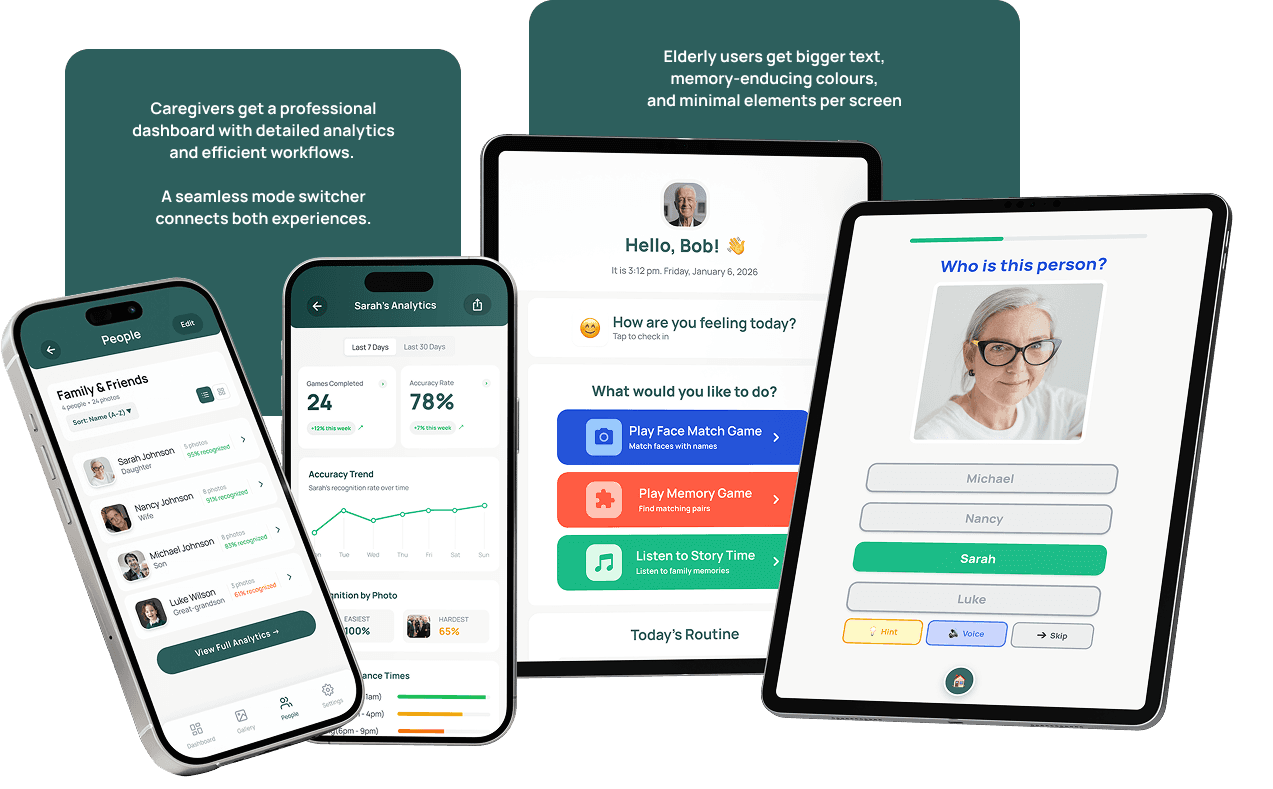
The insight: Designing for two vastly different user groups with conflicting needs: elderly users with cognitive decline who need radical simplicity, and caregivers who need efficient, information-dense tools.
The solution: Dual-Mode Architecture
Rather than compromising on either experience, I designed two complete interfaces that share backend data but present dramatically different UX.
Failure is devastating
The insight: "When he gets the answer wrong, he shuts down completely. He won't try again." Traditional game mechanics (scores, timers, "wrong" feedback) trigger anxiety and avoidance in dementia patients.
The solution: Dignity-First Game Design
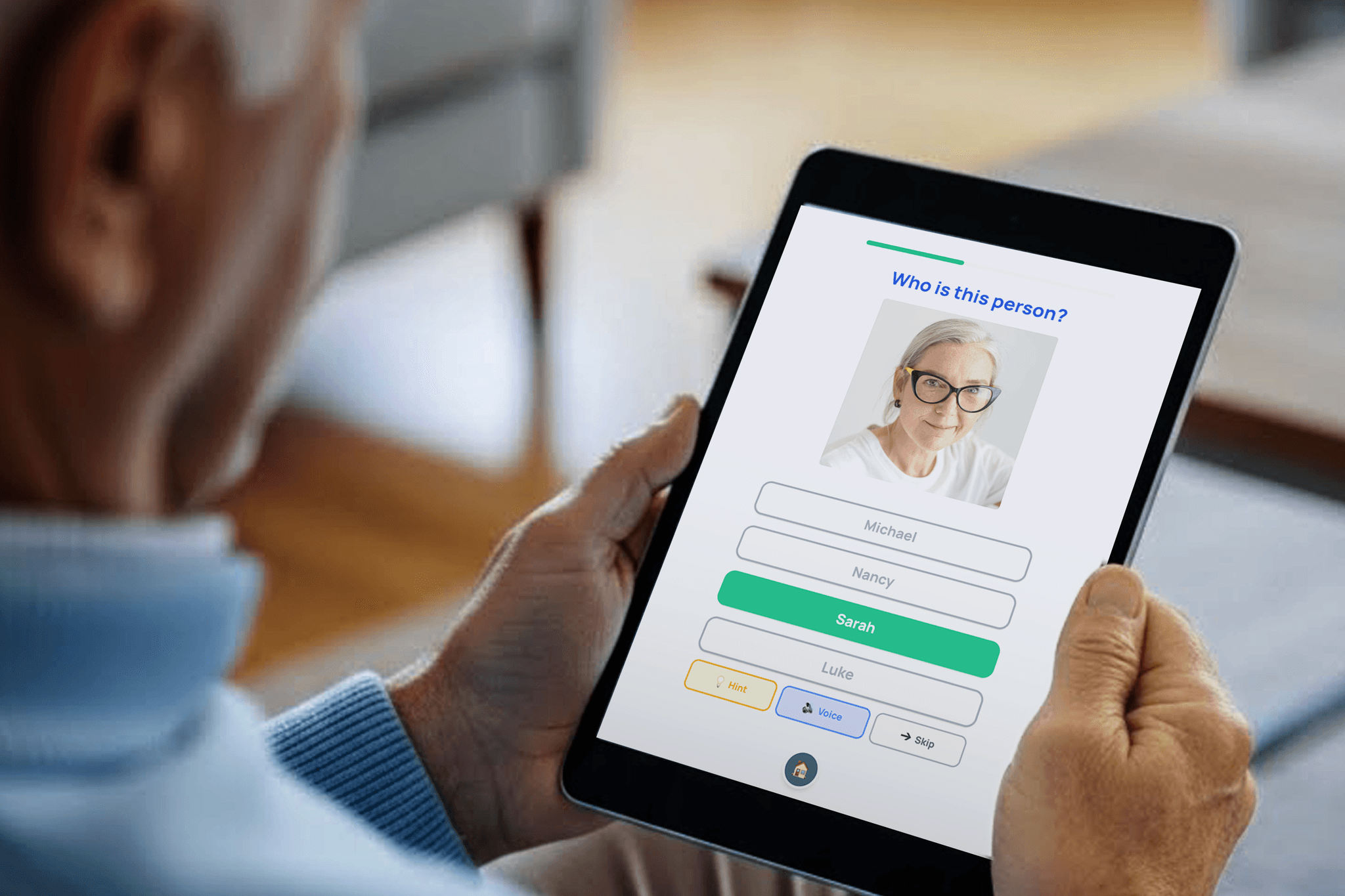
I reimagined game mechanics entirely. No timers, no scores, no "wrong" feedback. Incorrect answers receive a gentle "Let's try again" with the photo still visible. Unlimited attempts until success. Progress framed as "You recognised 8 family members today!" rather than percentages. Every interaction preserves self-worth.

Generic content doesn't connect
The insight: "She doesn't care about random old photos. She wants to see her grandchildren." Users strongly prefer personal photos and music over generic content, recognition rates improve 3× with familiar faces.
The solution: Family-First Content System
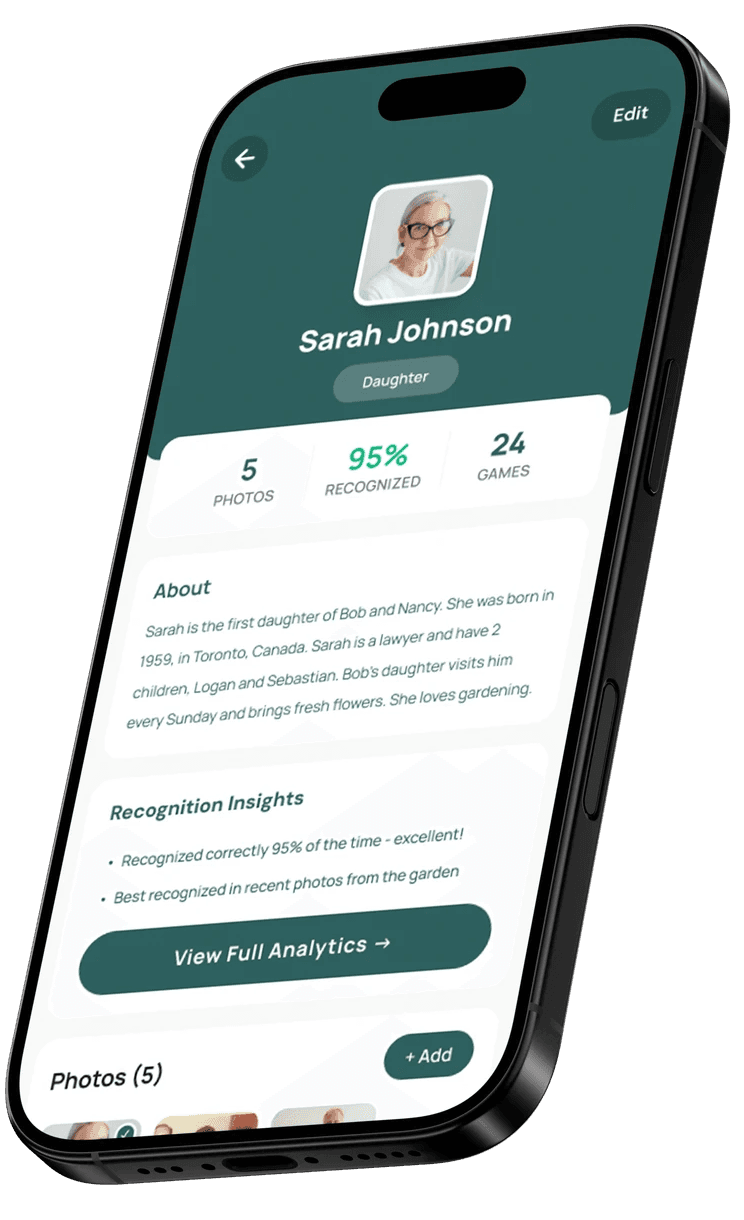
Built a sophisticated photo management system with face detection, automatic grouping by person, and smart recommendations based on recognition success. Added music-photo associations—when Bob views his wedding photo, his wedding song auto-plays. The Life Story Builder lets caregivers create narrated photo slideshows organised by life chapters.
Caregivers lack evidence
The insight: "The doctor asks 'how is he doing?' and I don't know what to say beyond 'he seems confused more.'" Caregivers have no objective data to share with healthcare providers.
The solution: Progressive Disclosure Analytics
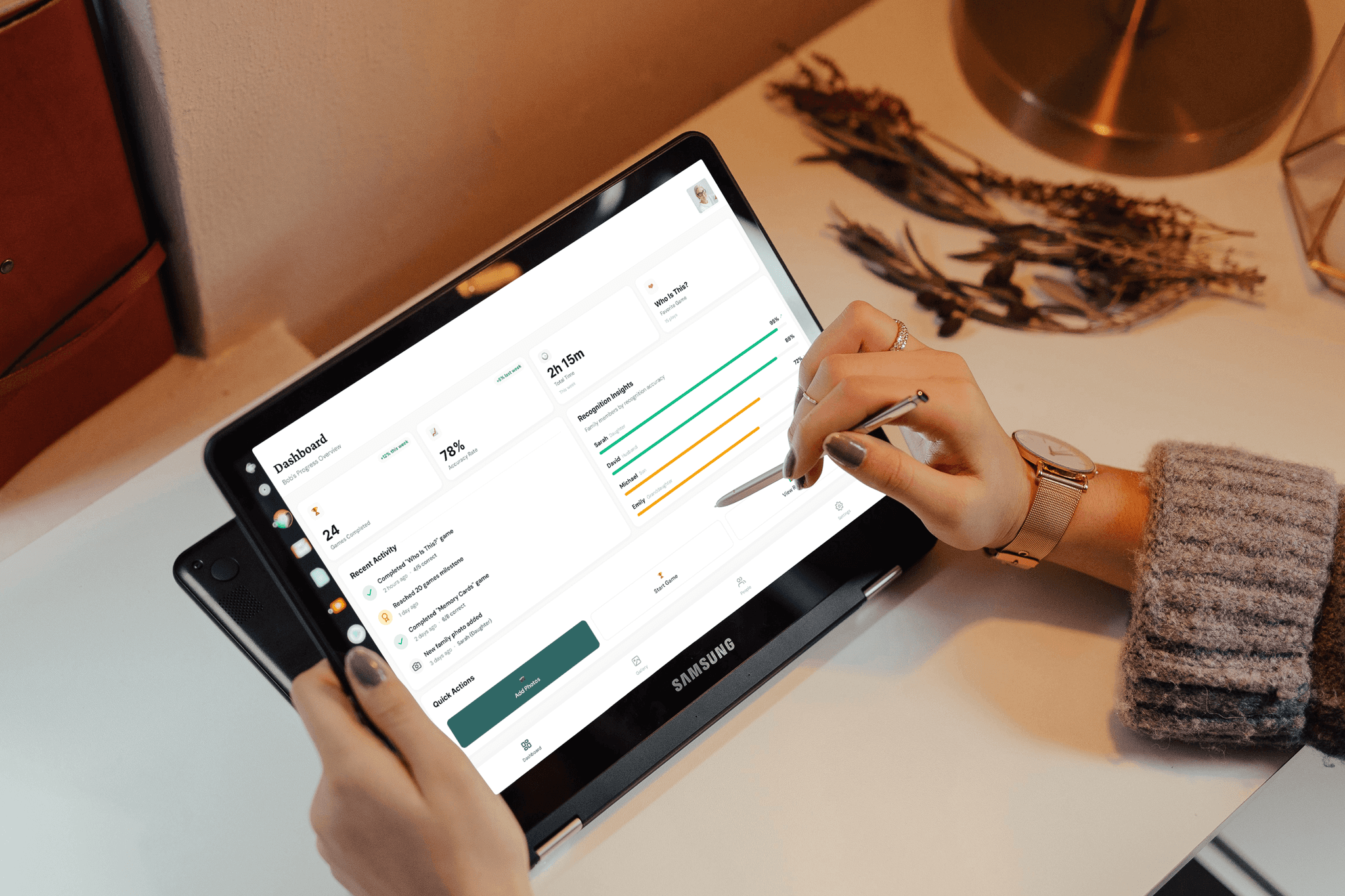
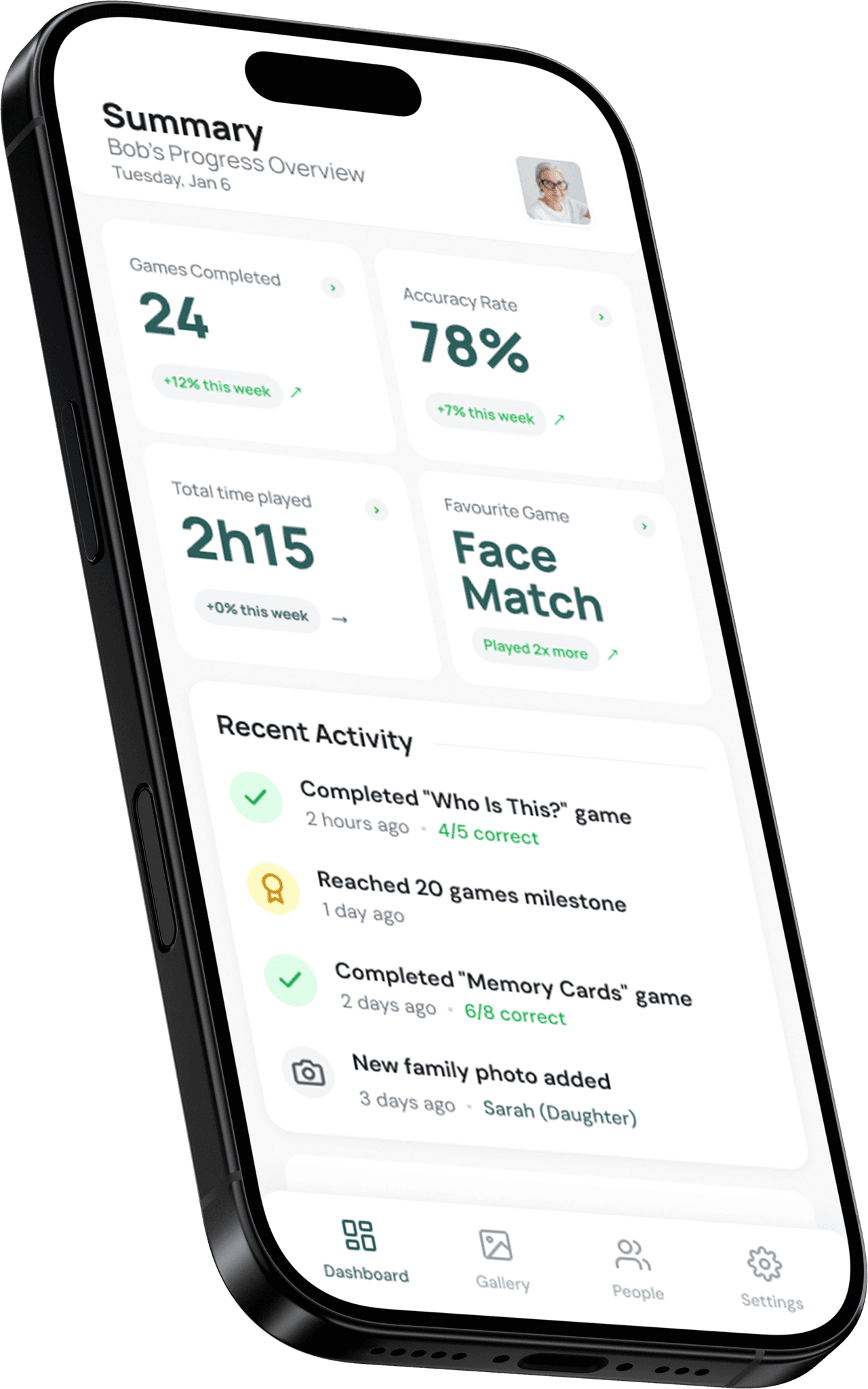
Designed a three-level data system: dashboard glance (10 seconds) with 4 key metrics and trend arrows; detailed reports (2 minutes) with weekly/monthly comparisons and person-by-person recognition rates; and clinical export (PDF reports) for doctors with longitudinal data over 6–12 months. AI insights surface patterns like "Bob does better in mornings."
Family coordination is chaotic
The insight: "My siblings all upload photos separately. Nobody knows what anyone else is doing." 70% of Alzheimer's care involves 3+ family members, but coordination happens via scattered texts and emails.
The solution: Family Collaboration Hub
Created a multi-caregiver platform with role-based permissions, shared calendar for coordinating visits and appointments, real-time activity feed ("Sarah uploaded 5 photos"), and a private family message board. Weekly email digests keep low-tech family members informed. Average accounts have 3.5 family members; projected 25% reduction in caregiver stress.
Designing for progressive decline
The insight: Dementia is progressive. How do we design for someone who will change significantly over time?
The solution: Adaptive Complexity Levels
Designed three modes—Standard (3 choices, mixed difficulty), Simplified (2 choices, only very familiar people), and Assisted (caregiver plays alongside). AI-powered automatic adaptation suggests simpler modes after repeated struggles and gradually adds challenge after successes. The system tracks performance over weeks and alerts caregivers to changes—all while preserving dignity through gentle transitions.
( 04 )
key lessons
Empathy without pity
People with mental decline are adults with decades of life experience. They deserve respect and dignity, not childlike interfaces.
Don't compromise, design twice
Serving two audiences with one interface frustrates both. Two great experiences with shared data is the answer.
Reframe "failure"
Progress isn't about getting things right, it's about staying connected. Remove all mechanics that punish mistakes.
Personal is powerful
Generic content can't compete with a photo of your grandchild or your wedding song. Design for personalisation from day one.


( 00-03 )
DISCOVER MORE
Want to check more?
Discover our other projects.